Every enterprise AI initiative starts the same way: a pilot that feels magical, a demo that wins the boardroom, and a production rollout that quietly disappoints.
The model is the same. The prompts are refined. The budget is approved. Yet the agent hallucinates policy exceptions, cites outdated documentation, ignores regional constraints, and confidently answers questions it was never authorized to touch.
The failure is rarely the LLM. It is almost always context—what the system chose to show the model, what it withheld, and how it assembled that bundle at decision time.
We spent 2023–2025 obsessing over prompt engineering: crafting the perfect system message, tuning temperature, iterating on few-shot examples. That was necessary. It is no longer sufficient.
In the agentic era, the competitive advantage shifts from how you talk to the model to what you allow the model to see. Context engineering is the discipline of designing, governing, and operating that visibility layer. For CTOs, it is rapidly becoming as foundational as API gateways were to microservices—or as IAM was to cloud adoption.
Why prompt engineering hits a ceiling
Prompt engineering optimizes a single interaction: one user, one task, one bounded conversation. It assumes the relevant information can be hand-curated into the prompt window.
Agents break that assumption. They:
- Chain dozens of tool calls across systems.
- Operate on behalf of multiple users with different permissions.
- Run asynchronously—without a human watching every step.
- Accumulate state over hours, days, or entire workflows.
When an agent misfires in production, the post-mortem almost always reveals the same pattern:
The model did exactly what it was capable of doing with the context it was given.
Common failure modes:
- Over-stuffing: Dumping entire knowledge bases into the prompt until the model loses signal in noise.
- Under-scoping: Retrieving generic FAQ content when the decision required account-specific policy data.
- Stale context: Serving last quarter’s pricing rules because the vector index was never refreshed.
- Permission bleed: Including document snippets the requesting user should never access.
- Missing constraints: Omitting regulatory boundaries, approval thresholds, or jurisdictional rules.
Prompt tuning cannot fix a broken context pipeline. You cannot prompt your way out of retrieving the wrong data.
Context engineering defined
Context engineering is the intentional design of everything that enters an model’s working memory at inference time—plus the policies that govern assembly, freshness, and provenance.
It spans four layers:
| Layer | What It Controls | Failure If Neglected |
|---|---|---|
| Retrieval | Which facts, documents, and records are candidates for inclusion. | Hallucination or generic answers. |
| Ranking & Compression | What fits in the token budget and in what priority order. | Critical constraints dropped silently. |
| Memory | What persists across turns, sessions, and agent runs. | Inconsistent behavior; context drift. |
| Policy & Provenance | Who may see what, from which source, with what assurance level. | Compliance violations; unauthorized disclosure. |
The output is not a prompt template. It is a context contract: a deterministic specification of what an agent is allowed to know when making a decision.
The shift from RAG-as-feature to RAG-as-platform
Most enterprises treated Retrieval-Augmented Generation (RAG) as a feature bolted onto a chatbot: index some PDFs, wire up a vector store, ship.
That approach works for internal FAQ bots. It collapses under agentic workloads.
Agents need composable, policy-aware retrieval across:
- Structured systems (CRM, ERP, billing, IAM).
- Unstructured corpora (policies, runbooks, contracts).
- Real-time signals (inventory, incident status, market data).
- Organizational memory (prior decisions, escalations, audit trails).
The architecture question for CTOs is no longer “Do we have RAG?” It is:
“Do we have a context platform that every agent, copilot, and workflow can consume consistently?”
Winners treat context as shared infrastructure:
- One retrieval fabric—not twelve team-specific vector databases.
- Unified metadata schemas for source, owner, sensitivity, and expiry.
- Central policy enforcement—not ad-hoc filters per application team.
- Observable pipelines—you can answer why an agent saw what it saw.
Losers treat context as per-app glue code and wonder why each AI product behaves differently.
The five design principles CTOs should enforce
1. Context is a product, not a side effect
Assign ownership. Context pipelines need product managers, SLOs, and roadmaps the same way your data platform or API gateway does.
Define explicit outcomes:
- Precision: Does retrieved context actually answer the decision at hand?
- Recall: Are we missing authoritative sources?
- Freshness: What is the maximum acceptable staleness per domain?
- Explainability: Can we reconstruct the context bundle after the fact?
If you cannot measure these, you cannot govern agents at scale.
2. Separate retrieval from reasoning
The agent’s reasoning model should not also be responsible for deciding what data to fetch. Mixed concerns create untestable systems.
A robust pattern:
- Planner determines intent and required evidence types.
- Retrieval services fetch candidates from governed sources.
- Context assembler applies policy, ranks, compresses, and formats.
- Reasoning model operates only on the assembled, bounded bundle.
This separation lets you test retrieval independently—a prerequisite for enterprise reliability.
3. Encode permissions at the context layer, not the prompt
Telling an agent “Do not reveal salary data” in a system prompt is not security. It is hope.
Context engineering must enforce least privilege before inference:
- Filter at retrieval time based on the requesting principal (human, service, or agent).
- Apply field-level redaction and tokenization where needed.
- Log provenance: source system, document version, policy rule applied.
This aligns naturally with credential-centric identity models—agents should present verifiable authority before context is assembled.
4. Treat memory as a liability with a retention policy
Agents that remember everything eventually leak something.
Design memory in tiers:
- Ephemeral working memory: Current task state; cleared after completion.
- Session memory: Short-lived continuity for multi-step workflows.
- Durable organizational memory: Explicitly approved facts, decisions, and summaries—with owners, expiry, and audit trails.
Default to forgetting. Require explicit promotion to durable memory. The GDPR and compliance teams will thank you.
5. Build evals for context, not just outputs
Most AI eval suites score final answers: helpfulness, tone, factual accuracy. That is downstream of the real failure point.
Add context evals:
- Given this user and task, did we retrieve the authoritative policy document?
- Did we exclude deprecated content?
- Did the assembled context stay within permission boundaries?
- Would a human reviewer agree this is the minimum sufficient context?
When context evals fail, fix the pipeline—not the prompt.
Reference architecture: the context plane
A practical pattern emerging across mature AI-native organizations: 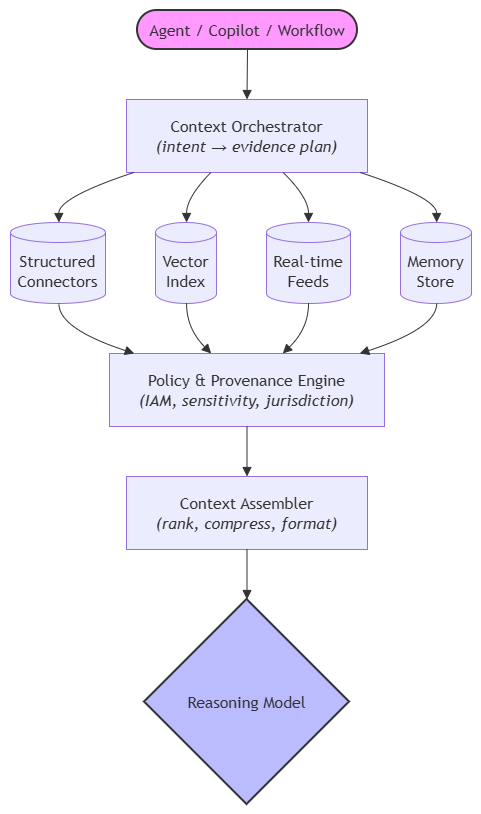
Each box is a platform capability—not a one-off script in a demo repo.
Strategic implications for technology leaders
For platform teams: The context plane is your next multi-year bet. Whoever owns it owns the quality ceiling for every AI product in the organization.
For security and compliance: Context is where data leakage happens in agentic systems. Invest here before you invest in another red-team exercise against the chat UI.
For product leaders: User trust in AI products correlates with context quality, not model brand. A smaller model with precise, governed context often outperforms a frontier model fed garbage.
For engineering orgs adopting the Orchestrator model: Your engineers’ primary artifact is no longer code—it is the context contract their agents operate under. Review those contracts with the same rigor you once applied to API schemas.
A pragmatic roadmap
Phase 1 — Instrument and inventory (0–90 days)
- Map your top five agentic use cases and the data each one touches.
- Audit current retrieval: sources, refresh cadence, permission model.
- Stand up basic context telemetry: what was retrieved, from where, for whom.
- Run context evals on historical failures—hallucinations often become obvious in hindsight.
Phase 2 — Platformize (3–9 months)
- Consolidate fragmented vector stores and custom RAG scripts into a shared retrieval service.
- Implement a policy engine at the context assembly layer.
- Define metadata standards: owner, sensitivity, TTL, jurisdiction.
- Separate retrieval services from agent application code.
Phase 3 — Govern and scale (9–18 months)
- Treat context SLOs as production metrics alongside latency and uptime.
- Integrate context evals into CI/CD for agent workflows.
- Extend the context plane to partners, suppliers, and external agents via governed APIs.
- Link context provenance to audit and compliance reporting.
The uncomfortable truth
The model wars are commoditizing. GPT, Claude, Gemini, and open-weight alternatives are converging on “good enough” reasoning for most enterprise tasks.
The durable moat is not which model you call. It is how well your organization curates, governs, and delivers context to that model at the moment of decision.
Companies that treat context engineering as prompt tweaking will build fragile agents that impress in demos and erode trust in production.
Companies that treat it as core infrastructure will ship agents that are bounded, explainable, and actually authorized to act on behalf of the business.
Prompt engineering got us to the starting line. Context engineering determines who wins the race.
Where does context assembly live in your architecture today—a shared platform, or scattered across individual AI projects? Are you evaluating outputs, or evaluating what your agents were allowed to see?
Comments
Have a question or a different perspective? Add a comment below.