In the fast-paced world of technology and business, leaders often face a paralyzed dilemma: the tension between speed (making a decision quickly) and correctness (making the perfect decision).
We are conditioned to believe that accuracy is paramount. In school, we are graded on getting the right answer. In engineering, a single bug can bring down a system. However, in leadership and strategy, the equation changes.
The pursuit of absolute certainty often incurs a hidden cost—the tax of delayed decisions. This tax is paid in missed market opportunities, stalled momentum, and team frustration.
The Illusion of Perfection
Many leaders fall into the trap of “Analysis Paralysis.” They wait for 100% of the data before making a move, believing that more information guarantees a better outcome.
While valid for high-stakes, irreversible choices, this mindset is fatal for the majority of day-to-day decisions. By the time you have perfect information, the opportunity has often passed, or the market context has shifted.
“If you wait for 90% of the information, you’re probably being too slow.”
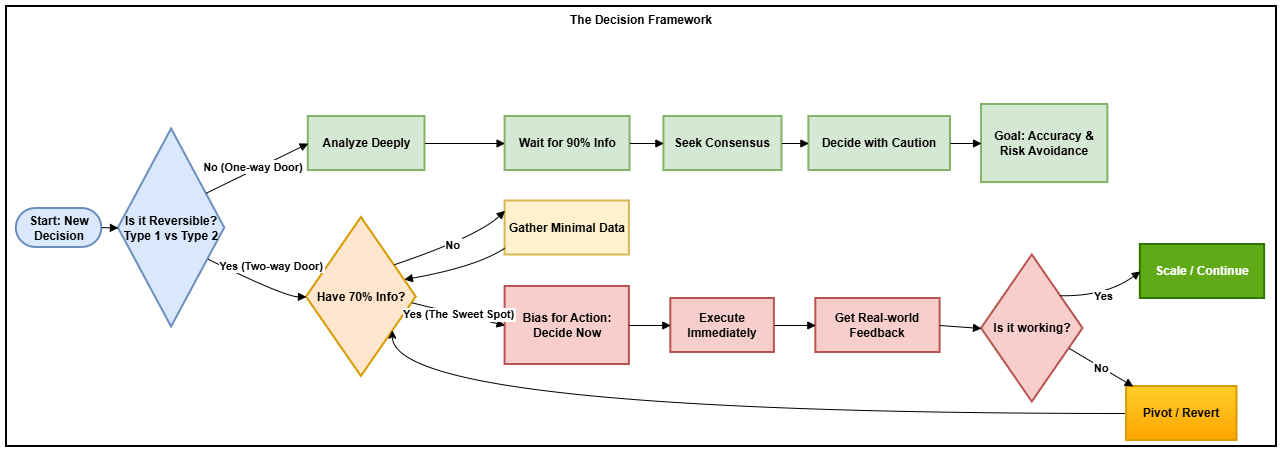
Type 1 vs. Type 2 Decisions
To navigate this trade-off, it is helpful to adopt the mental model popularized by Amazon’s Jeff Bezos regarding decision types:
- Type 1 Decisions (One-way doors): These are consequential and irreversible. Once you walk through, there is no going back. These decisions require deep deliberation, extensive data, and caution. Speed is not the priority here.
- Example: Selling the company, a major architectural pivot, exiting a market.
- Type 2 Decisions (Two-way doors): These are changeable and reversible. If you make a sub-optimal choice, you can reopen the door and go back. These should be made quickly by high-judgment individuals or small groups.
- Example: Trying a new marketing channel, launching a feature experiment, internal process changes.
The organizational failure occurs when we treat Type 2 decisions as if they are Type 1, applying heavy-weight processes to lightweight problems.
The Cost of Waiting vs. The Cost of Being Wrong
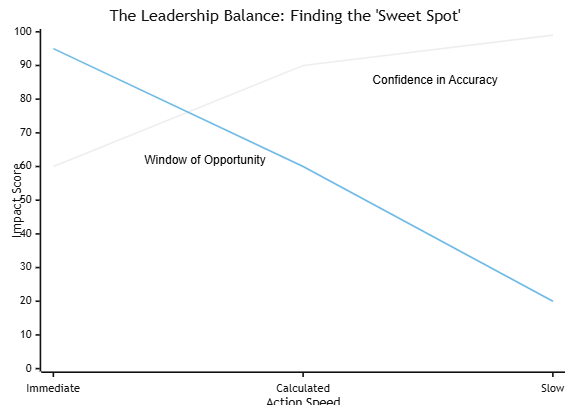
When we prioritize correctness over speed, we ignore the value of the feedback loop.
- Fast Decision: You decide, you execute, you learn. If you are wrong, you pivot quickly. You have gained valuable data from the real world.
- Slow Decision: You debate, you analyze, you delay. You have zero real-world data, only hypotheses.
Comparison: The two approaches
| Dimension | Optimizing for Correctness | Optimizing for Speed |
|---|---|---|
| Primary Goal | Risk avoidance and certainty. | Learning and momentum. |
| Data Required | ~90-100% of information. | ~70% of information. |
| Failure Mode | “Too little, too late.” Stagnation. | “Fail fast.” Course correction required. |
| Team Impact | Frustration, bureaucracy, disempowerment. | Energy, autonomy, rapid iteration. |
| Best Used For | Irreversible (Type 1) decisions. | Reversible (Type 2) decisions. |
How to Cultivate a “Bias for Action”
To reduce the invisible tax of delayed decisions, leaders must actively cultivate a culture of speed:
- The 70% Rule: Don’t wait for perfect data. If you have 70% of the information you need, go. The remaining 30% is usually discovered during execution.
- Disagree and Commit: Consensus is a speed-killer. Allow robust debate, but once a decision is made, everyone must commit to the execution, even if they disagreed with the choice.
- Delegate Authority: Push decision-making down to the people closest to the problem. They often have better context and can move faster than a centralized committee.
- Celebrate Correction: Remove the stigma of being “wrong” if the correction happens quickly. value the agility to fix mistakes over the pride of never making them.
Summary
Speed is not about recklessness; it is about recognizing that time is a non-renewable resource.
In a landscape defined by volatility and change, the organization that learns the fastest wins. And you cannot learn if you are standing still, waiting for the perfect answer.
Are you paying the invisible tax of delayed decisions?
Comments
Have a question or a different perspective? Add a comment below.