Secure OTA (Over-the-Air) updates are only as strong as the device’s boot integrity. One of the key expectations in the EU RED Cybersecurity Regulation is that software update mechanisms must be secure and verifiable.
This post explains secure boot for IoT SoCs and how it forms the foundation for trustworthy firmware updates.
Secure boot is a hardware-rooted security mechanism that ensures a device boots using only trusted, vendor-signed firmware and software.
Key takeaways
- Malware or unauthorized code from executing during boot.
- Rollback attacks by enforcing firmware version integrity (anti-rollback).
- “Bypass” of update security controls by ensuring only verified firmware can run.
Secure boot architecture in an IoT SoC
Root of trust (RoT)
Immutable code stored in ROM (Read-Only Memory) inside the chipset.
Purpose: Verify the authenticity of the next boot stage.
Common implementations:
- Hardcoded bootloader hash or public key
- ROM-based signature validation logic
Boot ROM
The first code executed on power-on.
Performs cryptographic validation (typically RSA/ECDSA) of:
- The first-stage bootloader
- Using digital signatures and a public key embedded in ROM (or OTP/eFuses, depending on the SoC)
Chain of trust
Each boot stage cryptographically verifies the next stage:
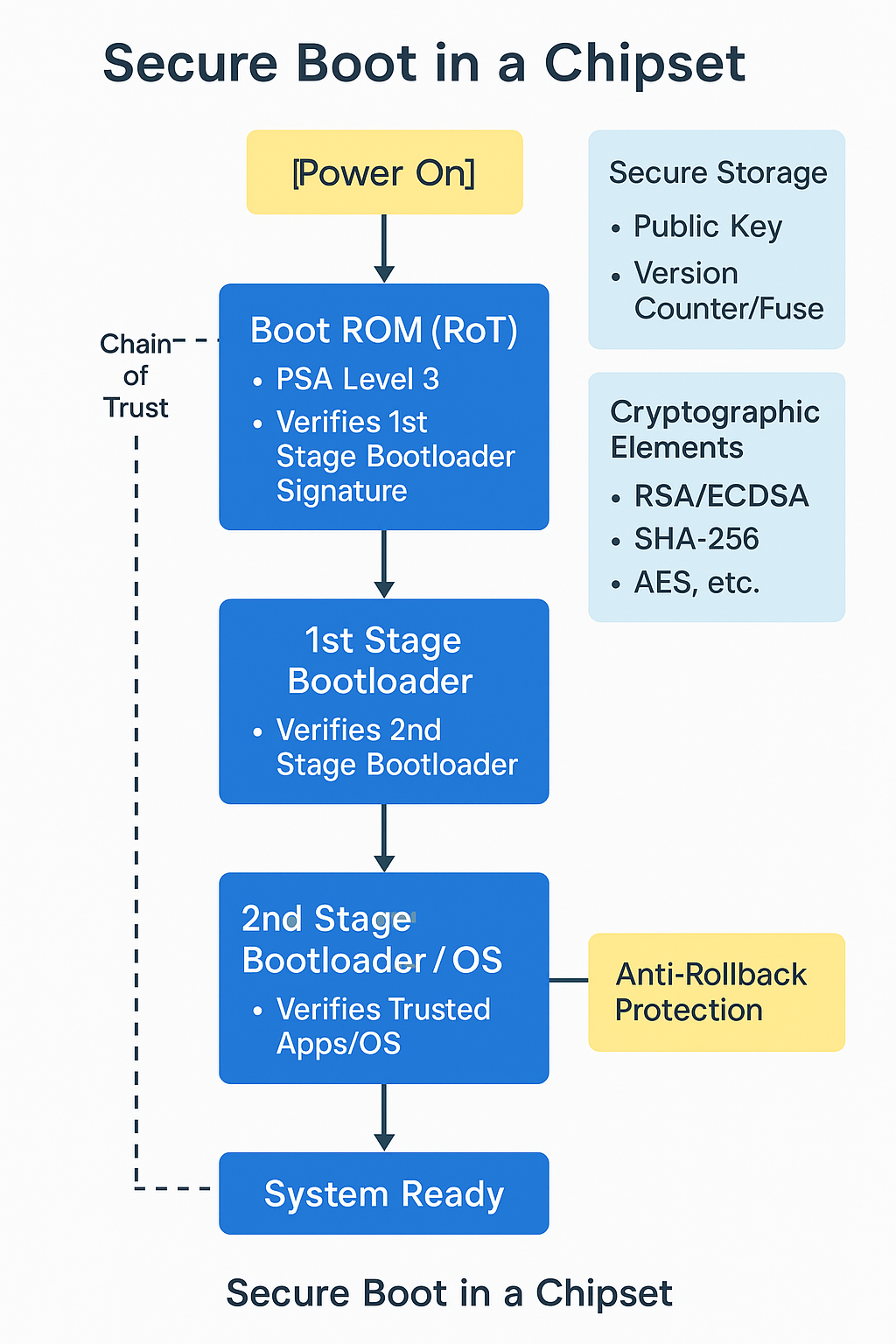
- Boot ROM → 1st stage bootloader → 2nd stage bootloader → OS kernel → trusted app/OS
If any step fails verification, the device typically:
- Halts boot, and/or
- Enters a recovery / DFU mode (platform-specific)
Cryptographic elements
- Asymmetric crypto (RSA, ECDSA): for verifying signatures
- Symmetric crypto (AES, HMAC): for encrypting or authenticating firmware
- Hashing (SHA-256/512): to ensure data integrity
Anti-rollback protection
Anti-rollback prevents firmware downgrade attacks (reinstalling an older, vulnerable image).
Common mechanisms:
- Monotonic counter / version fuses (eFuses or OTP memory)
- Signed firmware metadata including a version number that must monotonically increase
Key storage and signing
- Public key: burned into ROM or stored in OTP/eFuses (device trust anchor)
- Private key: held by the firmware signing authority (never on the device)
Secure firmware update (OTA) support
Secure boot is what makes OTA updates verifiable:
- Only signed updates are accepted
- Version checks prevent downgrades
Some platforms support encrypted firmware as well
Secure boot flow summary
-
Power on
↓
- Boot ROM (RoT)
- Verifies 1st stage bootloader signature
↓
- 1st stage bootloader
- Verifies 2nd stage bootloader
↓
- 2nd stage bootloader / kernel
- Verifies OS or trusted apps
↓
- System Ready
Example in practice (typical IoT SoC)
For an IoT SoC (e.g., Nordic, NXP, STMicroelectronics, Qualcomm):
- Boot ROM is fixed in silicon.
- Trust anchor stored in ROM / OTP / eFuses (platform-specific).
- Bootloader may use X.509 certificates to represent a chain of trust.
- Anti-rollback via signed version metadata and/or fuse-based version checks.
Benefits
- Ensures system starts in a known-good state
- Protects against bootloader or firmware tampering
- Forms the foundation for Trusted Execution Environments (TEE) and Secure Firmware Updates
Challenges
- Complex key management
- Device bricking if Secure Boot keys or policies are misconfigured
- Performance overhead during boot (mitigated with hardware acceleration)
Validating chipset security (PSA Certified)
Chipset security can be validated via Platform Security Architecture (PSA) certification: PSA Certified.
There are three PSA Certified security levels:
- Level 1: This is the foundational level, focusing on security best practices. It involves a questionnaire-based assessment to ensure compliance with baseline security requirements. It is ideal for demonstrating basic security measures
- Level 2: This level provides protection against scalable software attacks. It includes lab-based evaluations and vulnerability analysis to ensure the robustness of the device’s security features
- Level 3: The highest level, designed for devices requiring substantial assurance against both software and hardware attacks. It involves rigorous testing, including penetration tests and side-channel analysis, to verify the device’s resilience
FAQ
Is secure boot required for EU RED compliance?
EU RED is a regulation (not a single “checklist”), but secure boot is commonly treated as a foundational control because it enforces trusted firmware execution and supports verifiable updates.
Does secure boot automatically make OTA updates secure?
Not by itself. Secure boot ensures only trusted code runs at boot. For secure OTA, you also need signed update packages, anti-rollback, and a robust update/recovery strategy.
Which PSA level should I target for EU RED?
It depends on your product risk profile and threat model. For higher assurance devices, Level 3 is often used as a stronger benchmark.
Comments
Have a question or a different perspective? Add a comment below.